NextHive - The Transformer Model for Human Capability Development
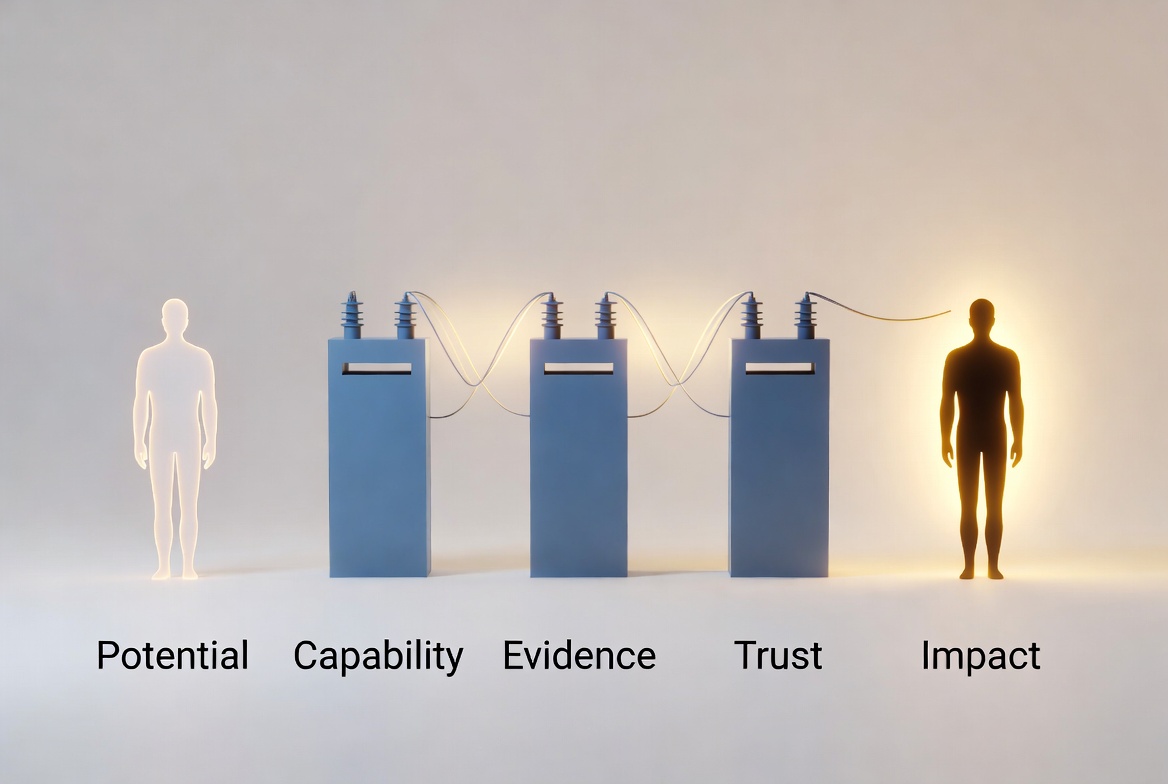
One of the questions we've been asked repeatedly is:
"What exactly is NextHive?"
Depending on where someone first encounters it, the answers tend to vary.
Some see an online learning platform.
Others see a collaboration platform.
Some focus on hackathons and innovation challenges.
Others notice portfolios, communities, events, notebooks, or professional networking.
Interestingly, none of these observations is wrong.
But none of them explains the whole.
Over the past few months, we've been refining a mental model that better captures what NextHive is actually designed to do. It has fundamentally changed how we explain the platform.
Think About a Power Transformer
A transformer doesn't create electricity.
It doesn't replace the power source.
Its job is to transform electrical energy from one state into another so it becomes useful for the next stage of its journey.
We believe NextHive should be understood in much the same way.
At the heart of our work is a simple belief:
Human potential is abundant.
Every day, we meet brilliant students, self-taught developers, researchers, creatives, founders, and professionals with immense potential.
Yet potential, by itself, rarely changes lives.
Somewhere between potential and meaningful impact, people get stuck.
That observation led us to develop what we call the Human Capability Development Lifecycle.
The Human Capability Development Lifecycle
Potential → Capability → Evidence → Trust → Impact
These are not features inside NextHive.
They are the stages of human development that matter most.
The interesting question then becomes:
What helps people move from one stage to the next?
That's where NextHive comes in.
Potential → Capability
Our courses, programmes, bootcamps, and learning experiences help transform potential into capability.
Capability → Evidence
Our Labs, projects, hackathons, challenges, and submission systems help transform capability into evidence by enabling people to build and demonstrate what they can do.
Evidence → Trust
Portfolios, professional profiles, communities, and social signals help transform evidence into trust, allowing others to confidently assess the quality of someone's work.
Trust → Impact
Once trust has been established, organizations, collaborations, opportunities, and real-world projects become the pathways through which trust becomes impact.
Not Separate Products—Transformation Engines
Seen individually, these look like separate products.
Seen through this model, they become something else entirely.
They are transformation engines.
Each exists for a single purpose:
To help people cross one important gap in their development journey.
This way of thinking has become an important design principle for us.
Whenever we're considering a new feature, we don't begin by asking:
"What should we build next?"
We ask:
"Which transformation are we helping people make?"
If the answer isn't clear, the feature probably doesn't belong.
Why NextHive Keeps Expanding
This perspective also explains why NextHive continues to evolve beyond what most people would recognise as a traditional learning platform.
Learning is essential.
But learning alone rarely changes outcomes.
People need places to:
- Practise
- Build
- Collaborate
- Receive feedback
- Earn credibility
- Be discovered
- Create impact
That's the ecosystem we're building.
Not a collection of disconnected tools, but a coherent system where every product exists to help people move from one meaningful stage of growth to the next.
A Different Way to Think About NextHive
That's how we think about NextHive.
Not simply as a platform.
But as an ecosystem of transformers for human capability.